Saturday, February 18, 2023

The digital divide is visible everywhere.


The AI is coming. And we must prepare for that. The worst thing we can do is try to slow advance with regulations like prohibiting some software. We must understand the opportunities that AI can give. But we must know that AI has a weakness. It doesn't know if the person who fills the forms tells lies. 

If AI doesn't get the right information. It's useless. Sometimes somebody says that AI takes our workplaces. But some other people ask what kinds of jobs the AI takes. Are they some well-paid and wanted workplaces? And would those skeptics make those works themselves? 

The digital divide between people increases inequity. The problem with the digital divide is that not formed between poor and rich countries. It's visible even in small workplaces and small communities. 

Even in western countries, and in high-tech corporations are people with no necessary computer skills. That kind of thing is problematic. We know that some people resist any kind of changes in workplaces. 

They use their power to deny things like Google Translate. The justification for those web-based applications is a risk to data security. Maybe the thing is true, but some people think it. That those prohibitions make their work slower and more difficult than it should be. 

During pandemics, we saw cases where people resist their remote work. They think that the workplace is meant for social behavior. But the problem is that the employer doesn't pay for social relations. The employer pays for work. And every euro that the employer pays for some other things is euro that the employer can put in some other place. 

Artificial intelligence is a good tool for many things. It is useful for a support system. The AI can use for sending personal support requests to the right person. If a person studies in some school the AI can offer the form, that the person can get the right help. If the person lost the password, the system doesn't need to call the doctor. Or if the person's work clothes break up. That doesn't mean that person needs some micro-support. 

When AI assists medical doctors with diagnosis, we must realize one thing. The AI must get the right information. When the AI starts the assistance. The patient can fill out the form like we do when we go to the dentist. 

But the problem is that the patient must give the right information. If the patient tells lies like claims to be a no-smoker but still smokes that thing causes a situation where the doctor might not even suspect that cigarettes cause some breathing problems. 

When we think about sleeping problems, alcohol use, and smoking. Those things can tell about mental problems, like stress. Many people think that it's embarrassing to talk about mental problems. And that's why there should be questions that person is easy to answer. 

Those questions can be questions, about sleeping, how much alcohol a person drinks, or smoking. And a computer can simply ask when the person goes to sleep. A person who fills out those forms must dare to tell the truth. If there are problems, the staff must find out the problem. We all have problems. 

And we must understand that we must not give up even if we are depressed. But are we depressed or just tired? This is one of the biggest problems. 

The researcher can ask how much a person walks, or make some other physical exercises. Those things tell about how the person handles life. And research is important for finding out the right way to help the person. 

When a team recognizes a person's need to get assistance or help they must know the problem. Without that thing, a person will not get the right kind of help. Sick leave is not always the right solution. 

If a person doesn't handle stuff. That is need for work causes stress. New situations are always stressful. And people must understand that thing. Things like a new environment, new responsibilities, and many other things are stressful. That thing causes sleeping problems. And if the person just plays some computer games all night long, that causes a situation that looks like depression. 

Does the person need a psychologist to tell the need to change lifestyle? The problem is that if a person has some kind of problem with computer games, sharing time, or some other things, that person needs help.  But how to describe the problem, or what makes something a problem?

Description for a gaming problem could be that person is late from lectures or work because that person plays some computer game. We can describe the problem using this description: those things start to dominate life. That domination is visible when the person is always late because of gaming etc. 

But the problem is that the person who has a gambling or game problem doesn't recognize the problem. The last one plays other computer games than gambling. When we see one visible problem, there might be more problems behind them. 


https://visionsoftheaiandfuture.blogspot.com/


Friday, February 17, 2023

The new hypothetical quantum engines and warp bubbles are the ultimate combination.


Wigner crystals can make even interstellar flight possible.  


When we think about the crafts that are mysteriously levitating over the ground we can think of situations in which the craft's body is in extremely low temperatures. And then laser ray will warm the ground under the craft. That thing can make the craft levitate. Because energy travels to the craft at an extremely high speed. 

In some other versions, the system uses superpositioned and entangled particles. Particles below the craft are at higher energy levels than particles in the engine. And that makes the quantum entanglement pull energy to the craft. 

Wigner crystals or fullerene balls where electrons are trapped can form symmetrical, sphere-looking energy impulses. If the graphene is formed in a Wigner crystal. There is a possibility that some engine has two layers of Wigner crystals. In those graphene layers is the superpositioned and entangled electrons. Those superpositioned and entangled electrons can send energy back from the system. If those layers are spherical that forms the ball-shaped power field. 


The internally installed fullerene balls can create a symmetrical sphere-shaped energy impulse


That means two graphene layers where electrons are trapped can use to make a new type of engine. In that engine, the system will put electrons trapped in those two graphene layers to superposition and entanglement. When the energy level of another electron layer is higher that thing makes energy flow to the side of the system where the energy level is lower. 

The mysterious sphere formed in the kilonova collision causes discussion. And interesting ideas. A spherical form of energy impulse can form a warp bubble. The mystery is why that kilonova formed a spherical energy impulse. 

Could there be some kind of phenomenon where a neutron star captures lots of electrons on its shell? If those electrons turn to positrons and then another electron hits them at the same time. That can form a pure spherical energy impulse. 

The fact about antimatter is that only mirror particles annihilate. The anti-electrons and neutrons can touch. So that thing can form a symmetrical energy impulse that travels inside the neutron star and then jump back from its nucleus. 


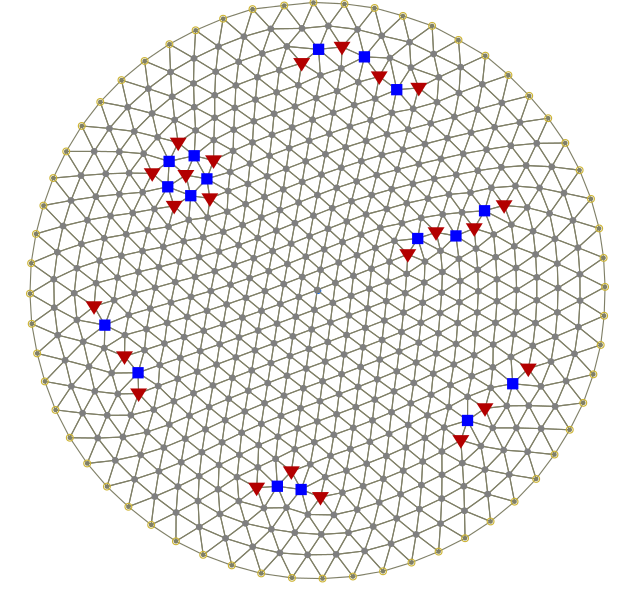
Wigner crystal. "Structure of a two-dimensional Wigner crystal in a parabolic potential trap with 600 electrons. Triangles and squares mark positions of the topological defects".(Wikipedia/Wigner Crystal)

Wigner crystal can be made by using graphene. 

The Wigner crystals can use for creating an absolute sphere-shaped energy impulse. And that thing can use for creating a warp bubble. 

In some ideas, the system can create warp bubbles by impacting neutrons. There is also the possibility that the fullerene can turn into an artificial Wigner crystal. 

In some models, the system creates a warp bubble by shooting positrons against the electrons trapped in the fullerene ball that turned into a Wigner crystal. That structure can form a pure spherical energy impulse. Because electrons are in Wigner crystals or fullerene balls. That system allows the creation pulsing warp field. or at least some kind of energy ball with a pure spherical form. 

Sometimes is introduced that those electrons can be replaced by using neutrons. But at this time, neutrons must anchor in that structure to the places where normally are electrons. And then, the neutrons will shoot to those neutrons that are in that crystal. 


https://en.wikipedia.org/wiki/Fullerene

https://en.wikipedia.org/wiki/Wigner_crystal


https://shorttextsofoldscholars.blogspot.com/

Thursday, February 16, 2023

Neuroimplants are the next-generation tools that can revolutionize the world.


Telepathy is a real thing, at least if people use implanted microchips for wireless communication. It's called technical telepathy. Implanted microchips allow people to exchange information between each other and machines using microchips implanted in their nervous system.

The neuro implants that stimulate the nervous system can give help with neural diseases like Parkinson's and maybe Alzheimer's. Those microchips stimulate the nervous system with electric impulses. The idea in that kind of system is that they increase the power of electric impulses that neurons give, or they just stimulate neurons. And that should deny immune cells attack against those things. 

There is a possibility that the microchips that are transmitting nervous signals can use to restore the ability to move transplanted extremities. And that system makes it possible to transplant feet or arms to people who lost them because of accidents and diseases. 

But neuro implants can also move prostheses. They can restore the ability to move things like hand or leg prostheses. Wireless communication allows the creation of robot hands that are easy to use as gloves. The problem with microchip-controlled prostheses has been the sore that the electrode needs. The wireless communication allows the neural chip can control the robot arm through the skin. 

The implanted microchips can also use for everyday payments. In that case, a similar microchip used in payment cards is put under the skin of the hand. That kind of microchip can also contain the personal data of the user. And it allows using that kind of microchips as the ID-card. 

But then we must realize that the implanted microchips can communicate via the internet. That kind of system can connect to a mobile telephone. And that allows controlling the telephone or computers without the need to use hands. 

The BCI (Brain-Computer Interface) allows to remote-control robots. The users who use those systems can control drone swarms. And implanted microchips allow people who have those chips to communicate with each other by exchanging information using those chips. 

An idea is simple the microchips put on Broca's and Wernicke's areas make it possible that people can use technical telepathy.  Also, animals that have those microchips can turn into biorobots. 

That thing makes intelligent pets possible. We can visualize the situation where a person forgets to load the body that paralyzed person needs for walking. The neuro-implanted parrot can put the electric cable to the socket. Or we can send the remote-controlled dog to the shop. In that case, we can put an order to shop. 

And then the workers will put the ordered goods in the basket that our pet pulls behind it. Then the RFID chip in our biorobot pet tells us that goods can deliver to that pet. Diogenes the Sinope gives inspiration for that kind of thing. That ancient philosopher sent his dogs to shop for him, and that man can be called the father of robotics. 

Neuralink and other implants that connect to the nervous system can change personality. But we know that there are people who need manipulation. The question about free will is: should a person have free will, in the case that person is dangerous to the environment? And, who describes dangerous behavior? 

The fake memories can use for mental manipulation. But the same technology can use for teaching people. The user of the system determines where that person wants to use it. So maybe someday that technology gives help with ADHD and other people with concentration problems. But that kind of system is extremely dangerous in the wrong hands. 

But the world is full of somehow dangerous technology. Things like cars are the same way, dangerous in the wrong hands. When people are talking about mental manipulation they highlight free will. But every day we can see what negative things free will can make. And in that case, I mean things like despotic governments and wars. 

If we say that microchips change their user's personalities, we must understand that people like violent prisoners might require that kind of mind manipulation. Those things are questions about free will. And this point, we must ask what if somebody could change Vladimir Putin's personality for a peace-loving leader? 

When we think about the microchips that stimulate neurons we can use those things as a learning tool. The system can drive information to those microchips. And then those chips can send those signals to the brain. 

If we think that the system uses similar technology as the eye implants that can restore the person's vision the system can record information. And then drive it to the optic nerve. Or microchips can stimulate Broca's- and optical lobe. And it makes it possible to create "fake memories". But in that case, those memories are used for good. 


https://neurapod.medium.com/neuralink-digital-telepathy-587d3bc45f9c


https://www.sciencealert.com/brain-implants-like-neuralink-could-change-your-personality-in-surprising-ways


https://artificialintelligenceandindividuals.blogspot.com/

AI and robots get a bigger role in the future battlefield.


The AI successfully flew the F-16 for 17 hours. 

The next-generation version of the fully automatized war machines is probably the AI-controlled jet fighter. The AI control can be useful in kamikaze- drone fighters that can be retired fighters that would be scrapped anyway. And that kind of drone is suitable for kamikaze missions. The kamikaze drones can also use sub-missiles against air defense or some other targets in their route. 

Still today human pilot wins the AI. But the fact is that AI is under development. The R&D process requires information collected from the tests. And the tests and follow-up data analysis with a multi-professional team where pilots, AI developers, and other technical and military specialists analyze data and then make the next plans and changes in systems. 

The major problem with the systems is that they are mechanically repeating. When a human pilot learns the mechanical and frequently repeating moves that target is easy to shoot down. But AI advances. And the success of drones in Ukraine is making it necessary to re-estimate the drones. Even if the drone's primary role is target recognition and fire control. It can equip with missiles. 

That forces the air defense to shoot the drone. Small-size quadcopters that drop hand grenades to enemy positions are also effective tools. Those drones can communicate with controllers by using radio systems or they can use laser communication. And laser communication tools can use for target marking and laser sights. 


Above: GLSDB


The laser sight is also suitable for laser microphones. And that makes this system a multipurpose tool. They can search for snipers from the roofs. And if those systems are armed, they can be extremely dangerous. Those quadcopters can take out snipers and destroy enemy positions. And that system can also detect enemy vehicles for artillery and aircraft. 

The quadcopter can drop from satellites, and if they have satellite-based communication that allows them to locate and attack targets, and observe secured areas. That location is on the other side of the world. The system can try to drop the bomb inside the hatches of missile silos. And that can damage or destroy the rocket inside its silo. 

In the future, the SDBs (Small-Diameter Bombs) can be shot against enemy targets from thousands of kilometers away from their targets with pinpoint accuracy. And those systems can terminate even single tanks or other vehicles from another side of the world. 

AI is the game changer. The next-generation versions of the Maverick missiles can have fire-and-forget mode. That kind of system is possible to create, by driving the similar guidance system that Javelin missiles use to those old-fashion missiles. 

Satellites can also point targets by using lasers. Or they can drop the GPS-controlled drone on the target's roof. And then those drones can aim at the position of the target. Another possibility is that drone sends radio signals for radar-homing missiles. That means drones operate like transponders. That thing can give even naval missiles good accuracy. And it's luck that Russians don't use that technology. 

The new tool on the battlefield is Ground-Launched Small-Diameter Bomb or GLSDB. The missile can shoot a small-diameter bomb to 250 kilometers away from the launch site. A similar technology used in GLSDB can install in ICBM missiles. That makes it possible to destroy targets with pinpoint accuracy from thousands of kilometers. 


There is the possibility that the conventional glide bombs. That is equipped with heat shields that can drop from orbiting trajectories. Also, modern nuclear weapons can use similar technology. That is used in pinpoint accurate bombs. The JDAM with nuclear detonator already exists. And the most modern nuclear weapons are very small. 

General Petraeus predicts that the use of robots become more general. And that means many tactics that are made for military and police work must be re-estimated. In the wrong hands, those tools are extremely dangerous weapons. They can use for searching for things like weapons and in the same way, as soldiers use them, they are suitable for the mafia and other kinds of criminals. So criminal organizations can use small drones as strikes. 

Robot aircraft are not a new thing.


Robot aircraft are not a new thing. But independently operating AI-controlled jet fighters are the new thing. Remote-controlled drones used for a long time for a strike, recon, and target missions. There are mainly three types of robot aircraft. The two first are in service or entering service very soon. The third one is just under development. 

Cruise missiles are also kamikaze drones. And they should be easy to shoot down. But those weapons are still in use, even if the human pilot should shoot them like in targeting practice. The bomber drone is the only modified cruise missile that drops smart bombs like JDAMs or SDBs to target. 


X-47


1) Remote-controlled drones. Those drones are radio-controlled aircraft. That requires time for communication between the drone and its operator. The multi-channel- or laser-based communication systems make those systems a little bit more complicated to jam than in movies. 

2) Semituatomatic drones. The killer drones are mainly this type of system. The drone will get flight parameters to some area, and when it recognizes something suspicious it tells that an operator. 

Semi-automatic drones can also be manned aircraft where an active radar-based altimeter keeps the right distance to the ground. So the system corrects the errors that the pilot can make. 

One version of that kind of system is the aircraft-operating ASAT. The military command center's supercomputers control the missile and the aircraft. There the computer calculates the impact point of the missile and satellite. Then the command center the aircraft's course which makes it possible to hit the satellite at the right point. 

Also, things like optical-seeker bombs can have semi-automatic launching systems. The mission downloaded to the weapon. And if the seeker notices a hostile target that system opens fire. The system is similar to face recognition software. And it can be found in Israeli Spice-class glide bombs. Or developers can easily modify those systems for that purpose. 

3) Full automatized AI-controlled drones. Those drones are not yet suitable for complicated missions. But R&D work around those systems is going on. That means the game is changing. And those systems are powerful tools. Even if there are many problems with prototypes, the purpose of tests is to collect data for the developers so that they can fix errors in the code and find the problems. 


https://edition.cnn.com/2023/02/14/opinions/petraeus-how-ukraine-war-ends-bergen-ctpr/index.html

https://www.foxnews.com/science/aviation-milestone-artificial-intelligence-flew-modified-f-16-fighter-jet-17-hours

https://defensescoop.com/2023/02/14/ai-agents-take-control-of-modified-f-16-fighter-jet/

https://www.saab.com/products/ground-launched-small-diameter-bomb-glsdb

https://www.kauppalehti.fi/uutiset/kokenut-amerikkalaiskenraali-cnnlle-ukrainan-sota-paljastaa-sodankaynnin-muutoksen-seuraukset-voivat-olla-karuja/500ef635-737c-4558-bd7c-b6c7a5193954


Link to  Gen. Petraeus interview: 

https://www.youtube.com/watch?app=desktop&v=1Lb2mAJ3bQs


https://changeanditsmanagement.blogspot.com/


Friday, December 30, 2022

Misunderstandings and AI.


There is a new law in California that denies misleading marketing. That is important. In cases where new highly automatized automobiles are sold to regular customers, the misunderstanding causes terrible situations. If customers don't realize that the AI-controlled autopilot cannot drive independently. And humans must control the vehicle in city areas. 

That thing can cause problems or accidents. So if the human just starts to sleep and lets autopilot handle situations, the result is a crash. When people are starting to use some AI-controlled tools or vehicles, they must get enough information about the real capacities of those systems. 

Especially city areas are complicated for vehicles. There are millions of things that can happen suddenly. And programmers must notice all of those situations. If situations like balls come suddenly to the front of the vehicle not described to the program code, that causes a risky situation because if the AI doesn't recognize risks it's dangerous. 

The difference between self-driving cars and Chat GPT-type artificial intelligence is that Chat GPT is a virtual product. If the Chat GPT makes something wrong that thing doesn't make physical damage. But if the AI-controlled car makes mistakes, that thing causes dramatic situations. 

Making AI-controlled killer robots is easier than making an AI-controlled car that transfers people and merchandise from point A to point B. This is an interesting thing about robotics and AI. A destroyer is easier to create than something positive and creative. The fact is that most of the AI and robot programs are not serving the military. But the only thing that people are noticing are killer robots. 

People notice negative things better than positive ones. When we think about Fritz Haber, chemist, and researcher. That man created the Haber-Bosch synthesis along with Carl Bosch. Haber-Bosch method means ammonia synthesis that allows the creation of synthetic fertilizers. 

That method could save billions of people because it allows the growing of corn more effectively. But the same man has the nickname "father of chemical warfare". He created chemical weapons during WW1. But after WW1 that man earned a Nobel prize. 

Same way, we see AI as a threat to humanity. But then we must ask what is the threat, that AI causes or forms? Is that threat the mass unemployment? Or is it something that we cannot even confess? Is that threat that we lost our position in other people's eyes? If robots are starting to make all the dirty work like cleaning and other low-paid jobs, we must ask ourselves, would we make those jobs?

Does AI take jobs from poor people? Or does it only take away the people from the workplaces to who we normally compare ourselves? That means that the lowest step from workplaces will be removed and replaced by using machines. 


https://www.independent.co.uk/tech/tesla-elon-musk-self-driving-ban-b2252223.html


https://artificialintelligenceandindividuals.blogspot.com/

Can we return after death?


The model for cloning a person and then, transferring memories to the new body was originally for interstellar spaceflights. The idea was to increase the lifetime of the crew by cloning the crew. And then, transfer skills and other things, that they have to the new body. The main question is: are those clones the same people as their predecessors?

Highly advanced technical instruments with biotechnology make it possible to clone people. But is that cloned person the same as its ancestor? That is a big question. If we make a clone and try to transfer all memories to that new body, we are facing one interesting thing. The neural network in our brains is not advanced enough. And that means the difference between the number of neural connections between children and adults is big. 

So we can say that the next body that the EEG gets is different than the first one. In this model, we are facing the idea that the memories stored in the EEG are the personality. And personality is the same thing as the person itself. But our experiences. Are modifying our personality. But the problem is that if we want to multiply the person, we must make a copy of the person's body. 

And then transfer to memories that person has to that body. There we are meeting one problem. There is a large number of neurons in the human neural network. 

There is also a large number of connections between those neurons. Those connections are making virtual neurons by connecting neurons in the human nervous system. And every single neuron handles one little memory unit. So making precise accurate copies of human memories require that all memories in the brain will copy. And transferred by using precise accuracy. 

But the biggest problem is the brain's ability to receive information. The number of neurons and their ability to create virtual connections is limited. Making human clones is possible. Those clones are embryos so they advance like "normal" embryos. 

Transferring memories to that new person requires that the person's nervous system is advanced enough. Theoretically, we can make a bio tank where those clones can advance and grow. The muscle-electric stimulation makes it possible to keep their muscles in good condition. 

But if we would grow those people or clones we must keep them in that tank for tens of years. Making that kind of thing in real life requires that the team can create adult clones. And that thing is impossible or at least very difficult to make. That thing requires that cells can cleavage very fast. And keep their genetic structure the same. 


Saturday, December 10, 2022

The AI as an artist.


What is special about the painting above this text? The thing, that makes it so special is that the "painter" behind the image is the AI. AI is one of the most interesting and fastest-advancing tools in the world. The next-generation AI can be productive. 

It can have virtual imagination. Which means it can interconnect existing datasets. AI is not as versatile as humans. But the AI can play chess better than humans or operate more effectively than humans in a certain area where the system needs a limited number of datasets. 

The new area of AI is the new creative AI applications. AI as a painter is not a bad thing if the person wants to win things art like competitions. The AI can search for information on what kind of paintings people are willing to see. AI can use many tools for that purpose. 

And the most effective is the wall where are images of famous or free paintings. Then the AI observes what images people will click larger. And then, the system can calculate how long people spend with some images. After that, the system can connect the components of the most liked paintings, and then make its version of that thing. 

How accurate results the AI can get depends on the data sources. If the system has access to the user's web camera and it can make them use microphones. And make them comment on those images so the AI can search for the changes in the voice. And especially where the person looks for see where the person looks at. And then the system can interconnect those most pleasing objects into one work.

AI can make better work applications than humans. In this case, the system must only see what kind of things please the consultant. 

Creative AI is an effective tool. It can make paintings and drawings by using a certain limited dataset. And that kind of tool can make it possible to cheat people who elect people to the workplace. Labor consultants are people who are reading many job applications in a day. So if the AI has access to the computer of the employment service the AI can search what kind of applications those consultants are open to most, and how much time they spend with the application. 

And then how many of those job applications are bringing interviews? Then the AI can search for components that please the consultant. And after that. The AI can render the image to please the consultant and then collect the components for an application. That should bring the interview. The applicant must just give parameters for the AI like what are the strengths and skills that the applicant has. And the AI modified those things and photographs into nice-looking applications. 


Image: 

https://www.nytimes.com/2022/09/02/technology/ai-artificial-intelligence-artists.html


The system can create quantum-correlated photons from sunlight.

"Correlated photon pairs, generated via sunlight-pumped spontaneous parametric down-conversion in a nonlinear crystal, demonstrate ghos...